
The modality
Root Cause Therapy — the modality underneath everything I do
Grounded, science-backed nervous-system work for high-functioning people who are done with rehashing their story for months and want something that actually shifts.
- Not talk therapy. Not hypnosis. Grounded, science-backed.
- Somatic & Root Cause Coach · Root Cause Therapy Practitioner (Level 1 & 2)
- 15+ years in the family violence sector
- Online Australia-wide · In-person in Central Victoria
- Phone: 0494 680 460
Root Cause Therapy is a guided nervous-system process that identifies and updates the original emotional learning behind a pattern you’re still stuck in today. Not talk therapy. Not hypnosis. Not woo. You stay awake, aware and in control the whole time. Delivered by Em Williams — Somatic & Root Cause Coach in Central Victoria and online Australia-wide.
The plain-English version
What Root Cause Therapy actually is (in plain English)
Root Cause Therapy is a guided process that finds the original emotional learning behind whatever pattern is still running you today — the pattern under the anxiety, the overthinking, the people-pleasing, the “I know what to do but I can’t seem to do it” — and updates it at the level of your nervous system. Not at the level of your thinking head.
The important thing to understand is that your “problem” almost never sits where you think it sits. If you’ve been trying to logic your way out of anxiety with better mindset work, or think your way out of self-sabotage with more discipline, and none of it has actually landed — that’s not a failure of effort. That’s you fighting the wrong opponent. The pattern is stored in your nervous system, not in your thoughts. So no amount of thinking is going to touch it.
Root Cause Therapy works with three anchor points: the original event (what actually happened), the belief your system took from it (what you decided about yourself, other people, or the world), and the sensation your body still carries (the physical response that keeps firing when a similar trigger shows up). We work at whichever of those three is the strongest doorway in on the day.
Here’s the metaphor I use most:
Think of it like cleaning out a filing cabinet. Somewhere along the way, your system stored an experience with a strong emotional charge attached to it — and it filed that experience with instructions along the lines of “if this ever happens again, feel exactly this way.” Decades later, the trigger looks completely different on the surface, but the file is still there, still doing its job, still pulling the same emotional response.
In a Root Cause Therapy session, we open the cabinet. We find the file. We throw some stuff out, sort some stuff, and file the rest where it actually belongs. Your system stops running the old program because there’s no old program left to run.
One important thing to be clear about: the memory itself doesn’t get erased. What gets updated is the emotional charge attached to it. You’ll still know what happened, if you ever need to remember it — you just won’t be reacting to it decades later. This is not memory-loss work. It’s memory-meaning work.
That’s it. That’s the modality. Everything else is detail.
The differentiator
Why it’s not talk therapy — and why that matters
If talking about the problem was going to fix it, you’d already be fixed. You’ve had the insight. You know your patterns. You might be able to name your triggers, quote your therapist, and explain your childhood to a stranger at a dinner party. And you still feel the same.
That’s not a failure of talk therapy. It’s the ceiling of it. Talking works with the conscious mind — the part of you that’s already worked out what’s going on. Root Cause Therapy works underneath the conscious mind, with the subconscious and the nervous system, which is where the pattern is actually stored.
Full comparison: Root Cause Therapy vs Psychotherapy
| Talk therapy / counselling | Talk therapy / counselling | |
|---|---|---|
| Works with | The conscious mind — talking, analysing, insight | The subconscious and nervous system — where the pattern is actually stored |
| The story | Central — revisited, examined, re-examined over time | A doorway — just enough to find the file, then we update |
| Progress | You understand yourself better | The trigger stops firing the same way |
| How it ends | Sessions are open-ended, often ongoing | Defined-end containers (6 sessions for the Soul Edit container) |
| The outcome | Insight | A nervous-system update |
Neither one is “better.” They’re aimed at different jobs. Talk therapy is the right tool if what you need is to be heard, to make sense of something recent, or to have clinical support for a mental health condition. Root Cause Therapy is the right tool if you’ve already done the understanding work and the pattern still won’t shift.
There’s no picking apart your problems for months. No rehashing your story on repeat. We spend a small amount of time on the story — just enough to find the original file — and then we do the update work. The change lands in your body, not just in your head. You know it’s landed because your next real-world trigger doesn’t hit you the same way.
This work sits alongside, not in place of, medical or mental health care. If what you need is a clinical psychologist or counsellor, that’s a different service — and I’d rather point you to the right person than try to be them.
Why it actually holds
The science behind it — neuroplasticity, memory reconsolidation, and why the change actually holds
I’m sceptical by nature. I’ve always been sceptical. If a modality couldn’t explain how it worked — really explain it, in neuroscience and physiology, not vibes — I wasn’t going to train in it, let alone offer it to a paying client.
Root Cause Therapy is grounded in two well-established mechanisms.
Neuroplasticity is the brain’s ability to form new neural pathways throughout life. The old idea that the brain gets “wired” in childhood and stays that way is out of date. Every experience you have shapes the pathways you’re running on. Strong emotional experiences form the deepest grooves — and those grooves become the automatic responses that keep firing decades later, even when the situation no longer warrants them.
Memory reconsolidation is the more recent piece. Research shows that emotionally significant memories can be updated when they’re revisited under specific conditions — a brief window where the memory becomes changeable and can be re-stored with different emotional information. Root Cause Therapy uses that window on purpose. It’s not talking about the memory. It’s updating what the memory means to your nervous system.
The everyday version: neurons that fire together, wire together — and the opposite is also true. New experiences weaken old pathways while strengthening healthier ones. Once the underlying emotional charge is gone, the pattern it was driving loses its fuel.
That’s why the change lands in your body. Not just in your head.
The patterns this work addresses
What Root Cause Therapy can help with
If you’re navigating any of the following, you’re squarely in what Root Cause Therapy is designed for. This isn’t a diagnosis list — it’s the pattern list. The kinds of things people arrive with and the kinds of things that shift when the underlying emotional learning updates.
- Anxiety, overthinking, running loops at 3am
- Feeling stuck despite doing all the right things
- Low confidence and self-worth
- People-pleasing and can’t-say-no patterns
- Boundaries that collapse the moment they’re tested
- Perimenopause overwhelm and emotional exhaustion
- Chronic tiredness and running on empty
- Emotional burnout from carrying too much for too long
- Self-sabotage and procrastination
- Fear of failure — and fear of success
- Imposter syndrome and business mindset blocks
- Attracting the same kind of relationship (or client) on repeat
- Parenting triggers and inherited family patterns
- Grief, anger, emotional overwhelm
- Disconnection from yourself — the “I don’t know who I am anymore” version
If your pattern isn’t on the list, that doesn’t mean the work isn’t for you. It usually means it’s a slightly different flavour of the same underlying thing. If you’re not sure, send me a message and I’ll tell you honestly.
Depending on where the pattern is showing up in your life, the work sits inside one of two containers: Personal Transformation coaching when the pattern is personal, and Business Transformation coaching when it’s showing up in the business.
A note on scope. Root Cause Therapy sits alongside — not in place of — medical or mental health care. It doesn’t treat clinical conditions and it isn’t a substitute for a psychologist, counsellor or GP. If you’re in acute distress or need clinical care, please reach out to your GP or Lifeline on 13 11 14.
What to expect
What actually happens in a Root Cause Therapy session
A Root Cause Therapy session is nothing like what most people picture. You’re not lying on a couch being analysed. You’re not being hypnotised. You’re not being asked to relive something painful in vivid detail. And you’re not being asked to “just trust the process” without knowing what the process is.
Here’s what actually happens.
We talk first. Not for hours. Long enough for me to understand what you’re arriving with — what pattern’s been running you, when it started making itself obvious, what you’ve already tried. This part is normal conversation. No jargon. No performative therapy voice.
We do a somatic anchoring step. Simple, guided, gentle. You’ll settle your nervous system before we go anywhere near the pattern. This is the safety piece — non-negotiable, and something you’ll be able to use at home afterwards for your own regulation.
We access the subconscious. You stay awake, aware, and in control the whole time. Your eyes might be closed; that’s the only difference. You can stop the session at any point. You can ask me anything at any point. Most people describe this state as deeply relaxed and surprisingly natural — like the space between fully awake and drifting off, but with clarity. Not hypnosis.
We find the file, and we update it. This is the actual Root Cause Therapy work. Guided, structured, and specific to what your system needs. It usually takes far less time than people expect.
We integrate. We come back to conversation, I explain what shifted and why, and you leave with clear at-home tools to embed the change over the following week.
Sessions are 2 to 2.5 hours for the Soul Intake; shorter for follow-ups within a container. You’ll always know what we’re doing and why. You’ll always understand what shifted.
How it runs from here
Root Cause Therapy - Online, in-person, or both
Root Cause Therapy works just as well over Zoom as it does in person. That’s not a marketing line — most of my clients work with me online, from wherever they are in Australia, and their results are equivalent to my in-person clients. The mechanism is the same. The container is the same. The only difference is whether we’re sharing a room or sharing a screen.
Virtual Root Cause Therapy sessions run on Zoom Australia-wide. You need a quiet room, a stable connection, and a couple of hours where you won’t be interrupted. That’s the whole set-up.
In-person sessions run from 51 Burns St, Maryborough — my home base in Central Victoria. I see clients in-person across the Central Goldfields and the wider Central Victoria region, including Maryborough, Bendigo, Ballarat, Castlemaine, Daylesford, Carisbrook, Newstead, Maldon, Clunes, Creswick, Hepburn Springs, Avoca, Ararat, Stawell and the surrounding towns. Not sure if you’re in my patch? Just ask.
The Soul Intake and the packages
How to work with me
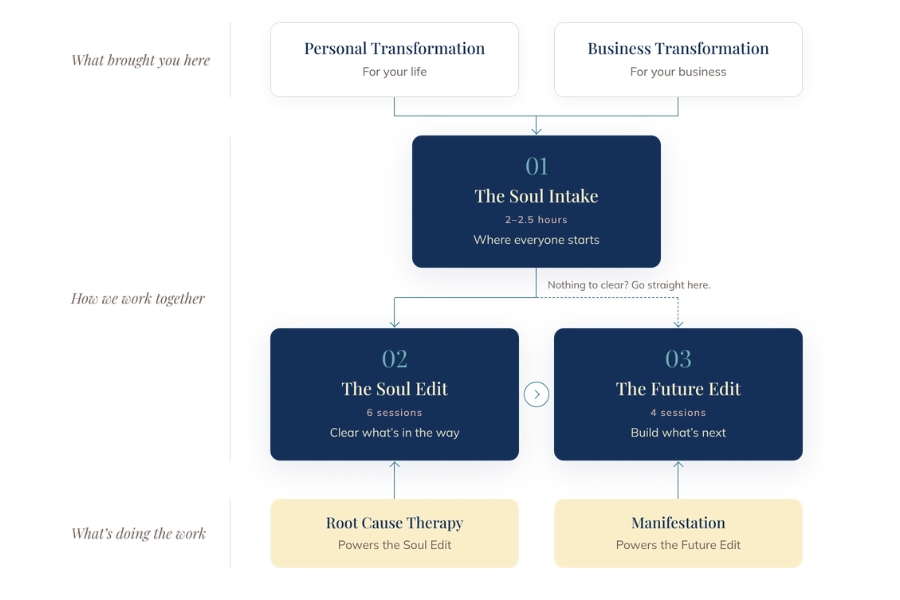
There are three ways into Root Cause Therapy with me. Everyone starts the same way — with the Soul Intake — and where you go from there depends on what your system needs.
01
The starting point
The Soul Intake - 1 session Foundation work
A 2 to 2.5-hour initial session on Zoom or in-person in Maryborough. We do the intake conversation, a somatic anchoring experience together, and — where appropriate — the first piece of Root Cause Therapy work.
You leave with at-home tools and clarity on what the next-step container looks like for you. The low-risk way in.
02
The core work
The Soul Edit 6-Session Container
Five past-focused Root Cause Therapy sessions plus one future-focused session, delivered over the timeframe that suits your system. Personalised reflections and integration practices between sessions.
Six sessions. A defined end. You leave with real change in your body and the tools to keep going — not a standing weekly appointment for the next three years.
03
When intent shifts to creation
The Future Edit - 4 Session Container
Four-session grounded manifestation work — nervous-system regulation, subconscious reprogramming, and the Akashic Records piece if it fits.
For the client whose intent has shifted from healing to creation. Vision boards and affirmations, with the nervous-system work that makes them stick.
Your life or your business, the path is the same. You start with a Soul Intake. If something old is in the way, we clear it in the Soul Edit. When you’re ready to build, that’s the Future Edit.
Prices for every package live inside my Practice Better booking portal so they’re always accurate. Flexible payment plans are available — I’ve kept it deliberately accessible for everyday clients. If you want to talk about which container fits before you book, send me a message or book a Root Cause Therapy consultation directly.
The practitioner behind the work
Who I am — the practitioner behind Root Cause Therapy at The Soul Edit Co.
I’m Em Williams. I’m a Somatic & Root Cause Coach, based in Central Victoria and working with clients Australia-wide online.
Before this work, I spent 15+ years in the family violence sector. What that means for you: nothing rattles me. You can bring the messy, the shameful, the “I’ve never said this out loud” — and I won’t flinch, won’t rush you, and won’t need you to make it prettier than it is.
If a modality didn’t have the science to back it, I wouldn’t have trained in it — and I wouldn’t be offering it to you.

- Certified Trauma-Informed Coach
- Root Cause Therapy Practitioner (Level 1 & 2)
- Certified Trauma-Informed Manifestation Coach (Level 1)
- Trained through The Centre for Healing (IAOTH & ICAHP accredited)
Currently completing Embodied Processing and Trauma-Informed Manifestation Coach Level 2.
What this work actually looks like
A real change, in her words
After our session, I had a conversation with my Nan that would normally trigger old patterns of control and seeking validation. This time, I stayed grounded, set a loving boundary, and backed myself without needing reassurance. I was able to express who I am now — steady, self-led, and no longer the insecure version of myself. This work has helped me break a core lifelong pattern. I feel more anchored, clear and self-trusting than ever.
— LJ
The questions I get asked most
The questions I get asked most about Root Cause Therapy
Is Root Cause Therapy hypnosis?
No. You stay awake, aware and in control throughout the entire session. Your eyes might be closed, but that’s the only surface similarity. It’s a guided process where your subconscious safely accesses and updates old emotional learning while your conscious mind observes. Most people describe it as deeply relaxed and surprisingly natural. You can stop at any point.
How is Root Cause Therapy different from talk therapy or counselling?
Talk therapy works with your conscious mind — the part that already knows the story. Root Cause Therapy works underneath it, with the subconscious and nervous system where the pattern is actually stored. There’s no picking apart your problems for months. We update the emotional programming directly, so the change lands in your body — not just in your head.
What does a Root Cause Therapy session actually look like?
We talk first — enough for me to understand what you’re arriving with. Then a somatic anchoring step to settle your nervous system. Then the actual Root Cause Therapy work — guided, structured, awake and aware the whole time. We finish with integration and at-home tools. The Soul Intake runs 2 to 2.5 hours. Follow-ups within a container are shorter.
How much does Root Cause Therapy cost?
Prices for every package live inside my Practice Better booking portal so they’re always accurate and up-to-date. Flexible payment plans are available — I’ve kept it deliberately accessible for everyday clients. Book a Soul Intake to see the options, or send me a message if you’d rather ask first. A $50 founding-client Soul Intake is currently available.
How long does it take, and how quickly will I see results?
Most people notice a shift after the Soul Intake alone. The core work is the Soul Edit 6-Session Container — six sessions, a defined end, delivered over the timeframe that suits your system. Results depend on the pattern and how long it’s been running, but Root Cause Therapy is designed for faster change than months of talking about the same thing.
Can I do Root Cause Therapy online?
Yes. Virtual Root Cause Therapy sessions run on Zoom Australia-wide and work just as well as in-person. Most of my clients work with me this way. You need a quiet room, a stable connection, and a couple of undisturbed hours. In-person sessions are available in Maryborough for anyone who’d rather sit across from me and the dog.
What’s the difference between Root Cause Therapy and EMDR or Somatic Experiencing?
They’re different modalities with overlapping outcomes. Root Cause Therapy is the modality I’m certified in — it works with the subconscious and the nervous system to update the original emotional learning behind a pattern. EMDR uses bilateral stimulation; Somatic Experiencing works primarily through titrated body sensation. I don’t hold certifications in either, so I don’t offer them. If one of those is what you need, I’ll point you to a practitioner who does.
when you’re ready
Ready to see what shifts when the root actually changes?
You’ve read the whole page. You know what Root Cause Therapy is, why it isn’t talk therapy, and what happens in a session. The Soul Intake is how you find out whether it works for you — a proper conversation, a piece of the actual work, and clarity on the next step. No pressure to continue.
Still have more questions
Founding client offer · limited time
The $50 Soul Intake
While I’m building the practice, I’m offering the Soul Intake — normally the full 2 to 2.5-hour foundation session — for $50. It’s my way of getting this work into the hands of the women who need it, and building the client library that will carry the practice forward.
Same session. Same depth. Same anchoring experience. You just get in for the price of a decent bottle of wine.